



Who Owns Mazda? History, Ownership, and the Road to 2030

If you’ve spent any time shopping for a new vehicle at Frank Boucher Mazda of Racine, there’s a decent chance you’ve wondered: who owns Mazda, and how does that affect the cars on the lot? It’s a fair question — especially in an era when automakers are merging, spinning off, and forming alliances left and right. The short answer is that Mazda is its own company, rooted in Hiroshima, Japan, with a 100-year history that’s a lot more layered than most people expect.
Key Takeaways
- Mazda Motor Corporation is a publicly traded, independent company — not a subsidiary of Toyota or any other automaker.
- Mazda is headquartered in Hiroshima, Japan, and has been since its founding in 1920 as Toyo Cork Kogyo Co., Ltd.
- Ford entered a capital tie-up with Mazda in 1979. Toyota later formed a strategic alliance in 2017, but neither company owns Mazda outright.
- Mazda launched its first vehicle (the Mazda-Go three-wheeler) in 1931 and its first passenger car in 1960. The RX-7 debuted in 1978 and became an icon.
- Mazda’s official roadmap targets a sustainable future through multi-solution powertrains, enhanced safety tech, and joyful driving experiences — on their own terms.
Who Owns Mazda? The Real Answer
What company owns Mazda is probably the most searched question about the brand — and the answer is simpler than most people expect. Mazda Motor Corporation is an independent, publicly traded company listed on the Tokyo Stock Exchange. No single corporation holds a controlling stake.
The confusion usually comes from two historical relationships. First, Ford Motor Company and Mazda entered into a capital tie-up in 1979 — a partnership that grew significantly over the years and helped shape both companies’ small-car lineups. Ford eventually divested its Mazda shares by 2015. More recently, Toyota formed a strategic alliance with Mazda in 2017, and the two companies co-founded the Mazda Toyota Manufacturing plant in Huntsville, Alabama, which began producing vehicles in 2021. Toyota holds a minority stake in Mazda through this arrangement.
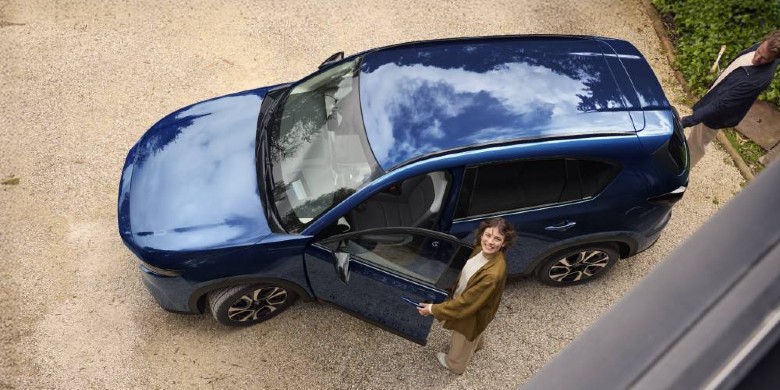
So did Toyota buy Mazda? No. A joint factory and a shared stake are not the same thing as an acquisition. Mazda’s design philosophy, engineering priorities, and product lineup are still driven by Hiroshima. The Toyota relationship gives Mazda access to EV development resources; it doesn’t hand Toyota the keys to the brand.
A quick look at Mazda’s major corporate relationships:
- 1979 — Ford Motor Company and Mazda enter a capital tie-up
- 2017 — Toyota and Mazda announce a strategic capital alliance and joint U.S. manufacturing venture
- 2021 — Mazda Toyota Manufacturing plant opens in Huntsville, AL; CX-50 production begins there in 2022
- Today — Mazda operates independently, traded publicly on the Tokyo Stock Exchange
Is Mazda Japanese? Yes — and the History Proves It
Is Mazda Japanese? Completely. Mazda Motor Corporation was founded in 1920 in Hiroshima, Japan, as Toyo Cork Kogyo Co., Ltd. — a manufacturer of cork products. That Hiroshima origin isn’t just a footnote; it’s central to the brand’s identity, especially given that Hiroshima was rebuilt from almost nothing after World War II. Mazda’s survival and growth through that period is a meaningful part of what makes the company what it is today.
The vehicle history tells the rest of the story. According to Mazda’s own corporate timeline, the Mazda-Go three-wheeled truck debuted in 1931 — the company’s first foray into transportation. Passenger cars arrived in 1960, and by the late 1970s, Mazda was doing something no other automaker had committed to: building the rotary engine at scale. The Savanna RX-7, launched in March 1978, was developed around the theme of driving pleasure. Its 12A two-rotor rotary engine was mounted in a front-midship layout, giving it outstanding handling stability, and it became a landmark sports car.
By November 1978, cumulative production of rotary engine models had reached one million units — a milestone Mazda’s own history highlights with pride. That rotary commitment, born in Japan and built in Hiroshima, is exactly the kind of brand identity that doesn’t come from a parent company’s boardroom.
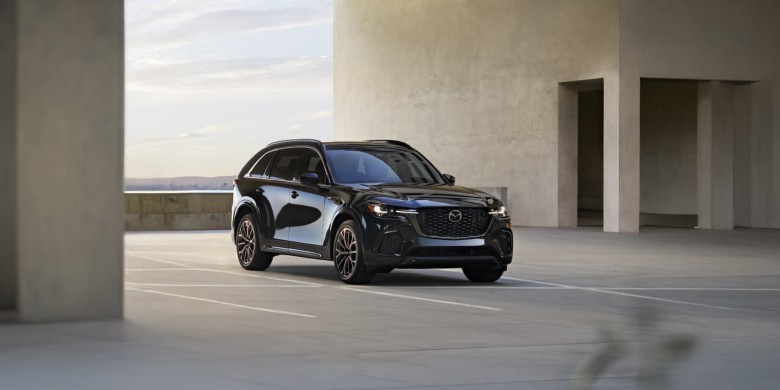
Key moments from Mazda’s official history (1920–1979):
| Year | Milestone |
|---|---|
| 1920 | Toyo Cork Kogyo Co., Ltd., founded in Hiroshima, Japan |
| 1931 | First vehicle launched: the Mazda-Go three-wheeled truck |
| 1960 | First passenger car introduced |
| 1978 (March) | Savanna RX-7 (1st generation) introduced |
| 1978 (Nov.) | Cumulative production of rotary engine models reaches 1 million units |
| 1979 | Cumulative exports to North America reach 1 million vehicles; Ford capital tie-up |
Where Is Mazda Headed? The 2030 Vision
Mazda doesn’t just have a history worth knowing — it has a future worth watching. The company has published a formal 2030 Vision, and its goals are specific. Mazda’s stated aim is to be a car-loving company that creates moving experiences through the joy of driving. That’s the headline, but the substance underneath it is what matters for shoppers thinking about where the brand is going.
Three pillars define Mazda’s 2030 roadmap. First, contributing to a sustainable Earth by providing multi-solution approaches to mitigating climate change. Second, contributing to a society where everyone feels safe to move freely through technology. Third, contributing to each person’s joy of living by delivering moving and emotional experiences.
On the U.S. side, the recent record speaks for itself. Mazda achieved record-breaking U.S. sales of 424,382 vehicles in 2024 — a 16.8% increase year over year — driven by the CX-90, CX-50, and CX-30. In 2026, the CX-5 continues its evolution as one of Mazda’s most enduring models. It looks like a brand executing its own plan.
Frequently Asked Questions
Who owns Mazda?
Mazda Motor Corporation is an independent, publicly traded company listed on the Tokyo Stock Exchange. No single corporation owns Mazda — Toyota holds a small strategic stake, but Mazda operates independently.
Is Mazda owned by Toyota?
No. Toyota and Mazda formed a strategic capital alliance in 2017 and co-own a manufacturing plant in Huntsville, Alabama, but Toyota does not own or control Mazda Motor Corporation.
Did Toyota buy Mazda?
Toyota did not buy Mazda. The two companies have a partnership focused on EV development and shared manufacturing, but Mazda remains its own company with its own leadership and product strategy.
Is Mazda a Japanese company?
Yes. Mazda was founded in 1920 in Hiroshima, Japan, as Toyo Cork Kogyo Co., Ltd. Its global headquarters remain in Hiroshima today, and the brand’s engineering identity is deeply rooted in Japanese craftsmanship.
What is Mazda’s 2030 Vision?
Mazda’s official 2030 Vision centers on three goals: contributing to a sustainable Earth through multi-solution powertrains, making transportation safer for everyone, and delivering joyful, emotional driving experiences.
Where are Mazda vehicles built?
Mazda builds vehicles in Hiroshima and Hofu, Japan, as well as at the Mazda Toyota Manufacturing plant in Huntsville, Alabama — where the CX-50 is produced — and at facilities in Mexico and other markets.
Contact Us
We Would Love To Hear From You.
Would you like to talk to us? Our friendly team certainly wants to talk to you! Whether you have a question, concern, or even just a comment, we want to hear from you, and this page is a great place to start. You can fill out the form that we have below to send us an email, or you can give us a call or stop in to see us in person. Either way, we look forward to talking with you and we can’t wait to help.
0 comment(s) so far on Who Owns Mazda? History, Ownership, and the Road to 2030